
Engaging the news without losing my soul
Some helpful things I'm learning about the nervous system

Hi Friends! This post was originally shared in March 2025, but the themes are as resonant as ever. I hope it meets you where you are with encouragement and care.
I was sitting in a cushy Airbnb, stealing away for some alone time, and scrolling on Instagram when I saw a post on my feed about the “shameful events that unfolded at the White House today.”
I felt my body brace for the worst.
The post gave no other context or details, so I hastily made my way to the comments section to put my internet sleuthing skills to work. After a few scrolls and taps, I had my clue: “Trump got in a fight with Zelenksy,” one commenter said. No other context.
My mind swirled. My thoughts were racing. Fight? What does that mean? Were fists thrown? Were expletives exchanged? What happened? I’ve gotta check YouTube…
I made my way to YouTube and had barely typed in “White House” before the search engine answered my exact question, as if by magic. The videos were right there: short form clips of their exchange, long form recordings of the entire conversation, and of course all sorts of commentary. I picked the short form video; time was of the essence and I had other things to do.
I watched for about three minutes and felt my stomach turn over a few times. I felt sad, disappointed, and afraid. Maybe even a little appalled or ashamed. I wasn’t in a headspace for analysis or judgment so I quickly switched back to Instagram to let other people tell me what to think. I have a selection of progressive and conservative commentators whose content I check-in with when I want to understand how news is landing across the political spectrum. The analysis wasn’t remarkable or surprising as both camps took their respective versions of the moral high ground, shaming their opponent and criticizing the other side for their fake news and rewriting of history.
I was stumped. I’d begun forming my own opinion which was helpful to a degree, but my body was still rushing with all of this anxious, fight-flight-freeze1 energy. By way of Instagram, my nervous system had noted a threat in my environment and jolted into self-protection mode. It was a whirlwind of emotions, information gathering, making judgments and assessing risk. My body was flooding with hormones preparing me to run for my life or play dead, all while sitting in this cushy Airbnb looking at my iPhone. This is ridiculous, I thought to myself. No wonder I avoid the news.
“Just get off the internet,” they say…
My go-to remedy for the madness of the news cycle has been to get off of social media and to limit how much news I listen to or watch. This has it’s many upsides as I do think social media is wildly unhealthy for the human soul and I do think our hearts can’t actually hold all of the emotionally charged information we’re exposed to each day. Real boundaries for our media intake are helpful and we need them.
However, I found myself in a tricky situation a few short days after the Inauguration when it became apparent to me that this new administration’s decisions were going to have an immediately felt, instantly harmful impact on all sorts of people and projects I care about. Of course, this is a classic case of waking up to one’s privilege. Privilege is an insulation from the negative effects of systemic harm; you don’t always know you have it until it’s threatened. I experienced a sort of privilege under the former administration because my work supporting African American communities was valued by them. The tide has turned and the type of work I do each day to support Black communities is more vulnerable now than ever. We’re not insulated anymore meaning I don’t have the luxury of checking out of the news cycle. I need to know if and when another executive order is going to cancel the contracts that support the landowners in our network. I need to know what’s happening on the ground with federal agriculture and forestry agencies. I can’t check out because it’s painful, scary, or hard. My ability to do my job depends on me being in the know.
Given that I can’t just opt-out of the news and media landscape—and given my commitment to leading a life that is slow, rooted, and doesn’t compromise my value for emotional well-being—I’ve been considering what it might look like to find peace by adding practices that support my nervous system instead of subtracting news and media. My theory is that if I can support my nervous system through bodily, regulating practices, then maybe it will expand my capacity to stay grounded in the midst of the chaos happening in the world.
Adding support for the nervous system
Your nervous system is this incredible network of nerves, your brain, and your spinal cord that controls how you respond to your environment2. It is a highly sensitive and remarkable communication system. Your nervous system is what enables you to see, to move, to speak and to feel3. Your nervous system is also finely attuned to the obvious and not-so-obvious threat and safety cues in your surroundings. Threat cues are signals that you’re in harm’s way, and safety cues are signals that you are protected and secure. Your nervous system’s number one job is to keep you alive, so it’s always scanning for safety and security, as well as threat and harm. It’s amazing.
What’s tricky about the times we’re living in is that a quick glance at your phone can send your nervous system into a full-blown threat spiral. You can be sitting in a cushy Airbnb holding a small computer (your cell phone) in your hands, but your body feels like it could be harmed in any given moment. It’s a painful aspect of the human experience in these times. So how do we add support for our nervous systems so that when we are triggered by the news, we can come back home to ourselves? Here are some things practicing:
Noticing when it happens. By simply noticing that I’ve been triggered by the news, I am able to reclaim a bit of my emotional energy and self-control. I mostly notice I’ve been activated by how fast I’m moving. My heart rate also increases and my drive to get all of the details is heightened. If I’m hastily jumping between apps and rapidly searching for more information, then it means I’m not functioning in a grounded, regulated state. When this happens, it helps me to just say to myself, “This thing is activating me and it doesn’t feel good.” By noticing this, I can then make a choice about how to respond instead of following the fight-flight-freeze script my body hands me.
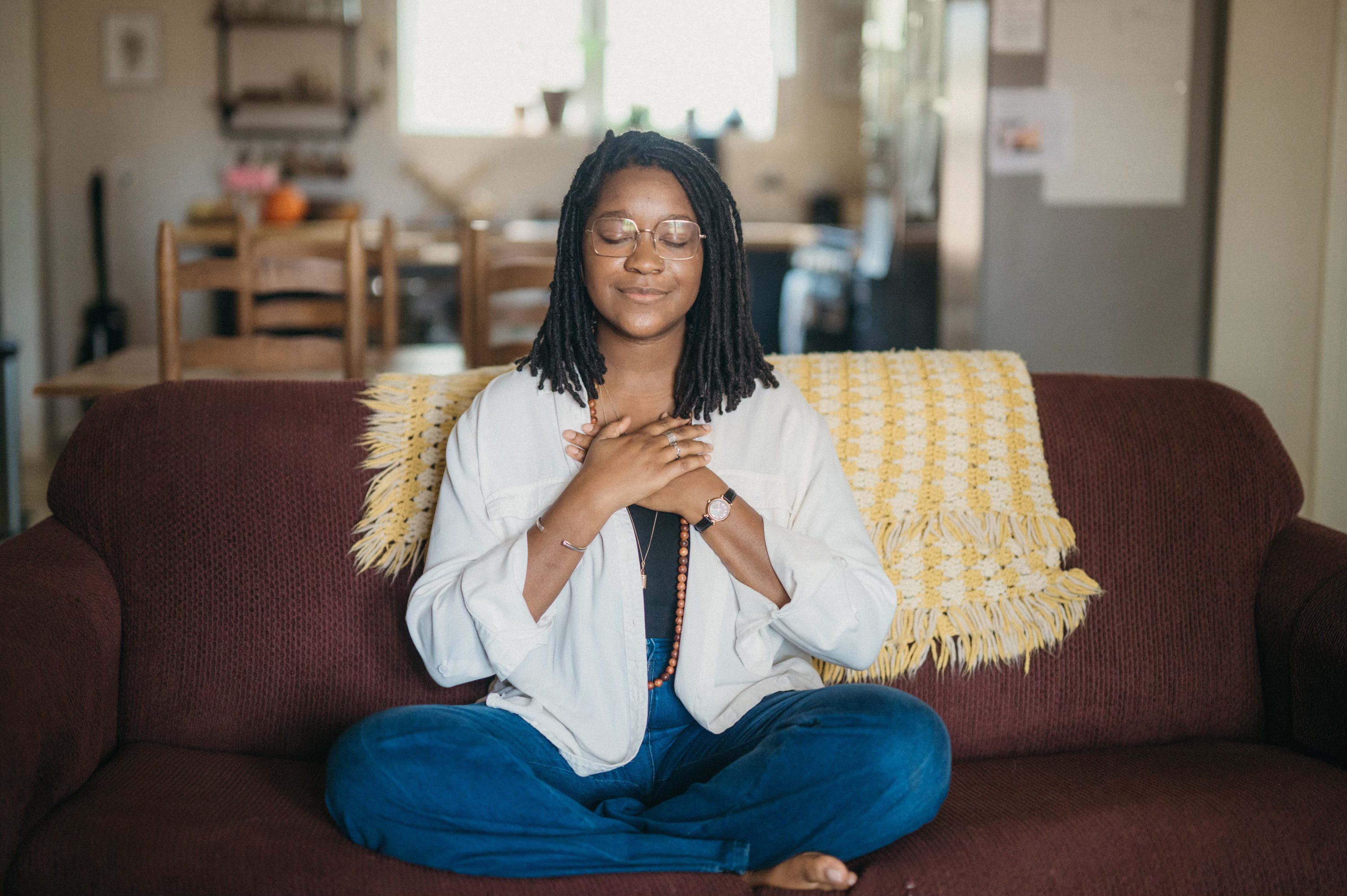
Breathing deeply. Nothing starts to reground me better than taking deep, deep breaths. It may take a few rounds of breathing before I feel it in my guts, but wow, leaning into the breath is one way to help my body know she’s safe. Quick and shallow breathing happens when you’re running from a bear. Deep and slow breathing happens when you’re getting a good night’s sleep. By slowing down the breath, and breathing as deeply into the belly as possible, and taking as much time as you need to feel your heart rate slow down, is a great next step after noticing you’ve been activated by something you read online.
Walking and talking it out. For especially distressing news, noticing and breathing are helpful, but they don’t always resolve the angst. Walking it out is an invitation to move your body. You can go for a walk, do some dancing, practice yoga—something to help the tension move through you instead of letting it continue to cycle inside of you over and over. Talking it out with someone who feels safe and grounded can also help your nervous system find security again.
Cherishing laugher, whimsy, and delight. Playfulness is one of the most vulnerable human expressions because it requires that you feel safe enough in your body and in your environment to embrace the fullness of joy. One way I’m learning to add support for my nervous system is by cherishing the moments I’m struck by the giggles, by the beauty of the world, or by the little tasks in my day that just make me happy. It may seem simple, but doing what you love creates resiliency. As the news gets wilder and as fears of the future loom large, keep creating and reveling in moments of joy.
These four practices are helping me stay engaged without losing my cool every moment of the day. I’ve also been experimenting with other wellness changes like cutting out alcohol, removing caffeine, wearing blue-blocker glasses when on screen at night, and getting really good sleep. These bigger picture lifestyle changes have also worked wonders and maybe I can write about those another time. I do still advocate for boundaries with media intake, but again, that’s not a luxury everyone can afford right now. I hope my reflections on these really simple practices helps you to add support to your nervous system as we move through these trying times.
With much love, and curiosity about how this lands with you,
Bethaney
P.S. I’ve been learning a lot about the role of nervous system regulation from this podcast, especially episodes 305 and 306. Enjoy!
Links to Stay In the Loop
These are ways our nervous systems’ respond to threat. We fight what we perceive to be threatening. We run from, or take flight from, what we perceive to be threatening. Or we freeze, get stuck, in the face of what we perceive to be threatening. There’s also fawn…which is where we cuddle up to what’s threatening us in hopes of that keeping us safe…but I didn’t include that one above.
https://kidshealth.org/en/parents/brain-nervous-system.html#:~:text=The%20nervous%20system%20includes%20the,the%20brain%20and%20the%20body.
https://my.clevelandclinic.org/health/body/21202-nervous-system
Thank you for sharing these tips, my friend. I also work in a field where I need to stay informed to better serve my community, so I can't completely tune out either. I appreciated your language of "adding to" instead of "subtracting from."
I love this, thank you. Some days I don’t know what to do with myself, I find myself holding my breath against what I may hear or read next.