
Extraction empties, reciprocity fills
To-do lists, splitting logs, and grappling with the conveniences of modern life

Rest and responsibility, I thought to myself. This is what it means to be at home.
A few weeks ago, Alex and I pulled up to our house after another long weekend of travel. We’d been out of town three weekends in a row, and just before that, I’d gone on a solo trip. Four weekends of being on the go.
We pulled into the driveway and sleepily made our way to the front door. In an instant, I was struck by two prominent thoughts:
One: I’m so tired and can’t wait to sleep in my own bed, and two: Now that we’re home, there is so much work to do.
The current line-up of tasks around Cedar Wilde (the name of our little home place) includes:
Building a cattle fence to enclose our acre
Building a shed for all the tools piled up on the porch
Installing new gardens beds, either raised ones or in-ground ones to accommodate our fall seedlings
Planting the extra fruit trees and the new willow tree, all of which are outgrowing their pots
Creating a larger chicken run that will not only protect the chickens from hawks, and their eggs from possums, but one secure enough to protect the chickens and eggs from our very cute pups
Oh, and did I mention the little pups? As cute as they are, they’ve become multiple chores unto themselves
I imagine that you, too, have a running list of tasks to accomplish in your home, for your kids, for your work, and more. This is what it means to be human. Any place in which we choose to create our lives requires care, especially if it’s to be a place of nourishment and rest. We go above and beyond to maintain and beautify our home places because we know we will not be sustained with out them. Our relationships to our places are reciprocal. As we care for the land, our homes, and for the creatures in our ecosystems, they care for us too. Not always in direct or immediate ways, but over time.
When I walked up to our house that day, and felt the weight of responsibility fall on my shoulders, I started thinking about what happens when we choose not take care of our home places. What happens when we opt-out of the physical and emotional processes of stewardship? In consideration of online movements calling for “self-care” and “rest”, I started to ask myself, Is true rest possible without responsibility? What is rest really, if it’s not rooted in a reciprocal exchange with all that lives with us and around us?
These are big questions. We want warm homes but have little connection with the responsibilities of splitting wood. We want healthy food without the responsibility of touching the earth and building healthy soil. We want intimacy without the responsibilities of emotional health and vulnerability. We want social justice without the responsibilities of humility, truth-telling, and repair.
Where does this leave us? Disconnected from the earth, from ourselves, and most certainly from one another.
Living in close proximity to big agriculture and industrial farming has been teaching me about all of this. I recently watched as farmers on large tractors began harvesting the hundreds, if not thousands of acres of cotton running up and down the highway nearest to my house. Every so often, I listened as the loud machinery cut and processed the plants. Within hours I watched as trucks drove off with massive, pillowy bales of cotton.
Where are they taking all of that cotton? I wondered. My best guess is that they are either driving it to a plant somewhere to be further processed, or they’re taking it to a shipyard to be exported somewhere far from here. I suppose I could go ask. Maybe I will one day. But for now, I find myself wondering about the cost of shipping this cotton to another part of the world. I’m wondering where the cotton in my own clothes comes from, and whether or not the people involved at every level of my clothing’s production were paid living wages for their labor. I’m wondering what it would be like if the agricultural lands surrounding me were converted into food growing operations to sustain the people who live right here. As talk of food shortages and shipping delays abound, what would happen if we were all empowered to cultivate resilience by growing food in our own backyards? Literally putting our hands to the plow to invest sweat equity in the long-term rest and nourishment we most need?
When we outsource the very basics of what we need to live, there’s a cost. Practically, there’s a cost to the planet as we strip the soil of nutrients it needs to be fertile. There’s also the cost to farmers who used to be able to make a living wage off of smaller farm enterprises, but due to a whole host of factors, are now only able to make money if they run larger-than-life operations.
There’s also a cost to me and you. When we’re disconnected from the truth of where our clothes, food, and warmth actually come from, we lose little bits of what it means to be creatures, created beings, on the earth. We miss out on the joy of working with our bodies to cultivate resilience for ourselves and communities. We miss out on knowing a place deeply and intimately. I don’t think it would be a stretch to say we even suffer from anxiety and a lack of purpose, as the land-based vocations that used to root our lives in specific places, inclusive off all the work that stewardship requires, have been traded for dislocation in service to convenience and technological “advancements.”
While I enjoy many of the modern conveniences of our day, living in closer proximity to the land, and to cattle and cotton farmers, has shown me how much hidden labor goes into sustaining those very conveniences.
When I lived in the city, I didn’t give much thought to these things. I didn’t have to. I couldn’t see the cost of my conveniences, so I didn’t think about them. I would go the grocery and food would be there. No need to think about who grew the food, so long as it wasn’t too expensive by the time I swiped my card for it. I felt similarly about my trash and waste disposal. So long as it was picked up in a timely fashion, it didn’t much matter whether or not it was truly recycled or if it found it’s way to a landfill— out of sight and out of mind.
When the holistic labor required to sustain our lives is hidden from us, we tend to feel little responsibility for or to that labor. Which is why, in stewarding a home place, there are countless lessons reminding you that there is always a cost to the rest and nourishment you most need.
One of the chores we recently took care of at Cedar Wilde was splitting the logs from an oak tree we took down nearly two years ago. The wood pile’s location was in the way of the new fence line, so we had to move it. One of my favorite childhood farm tasks was splitting logs. Not with an axe, but with a log splitter: a simple machine on which you load a log, pull a lever, and wait for the force of the spike to split the log into more manageable pieces.
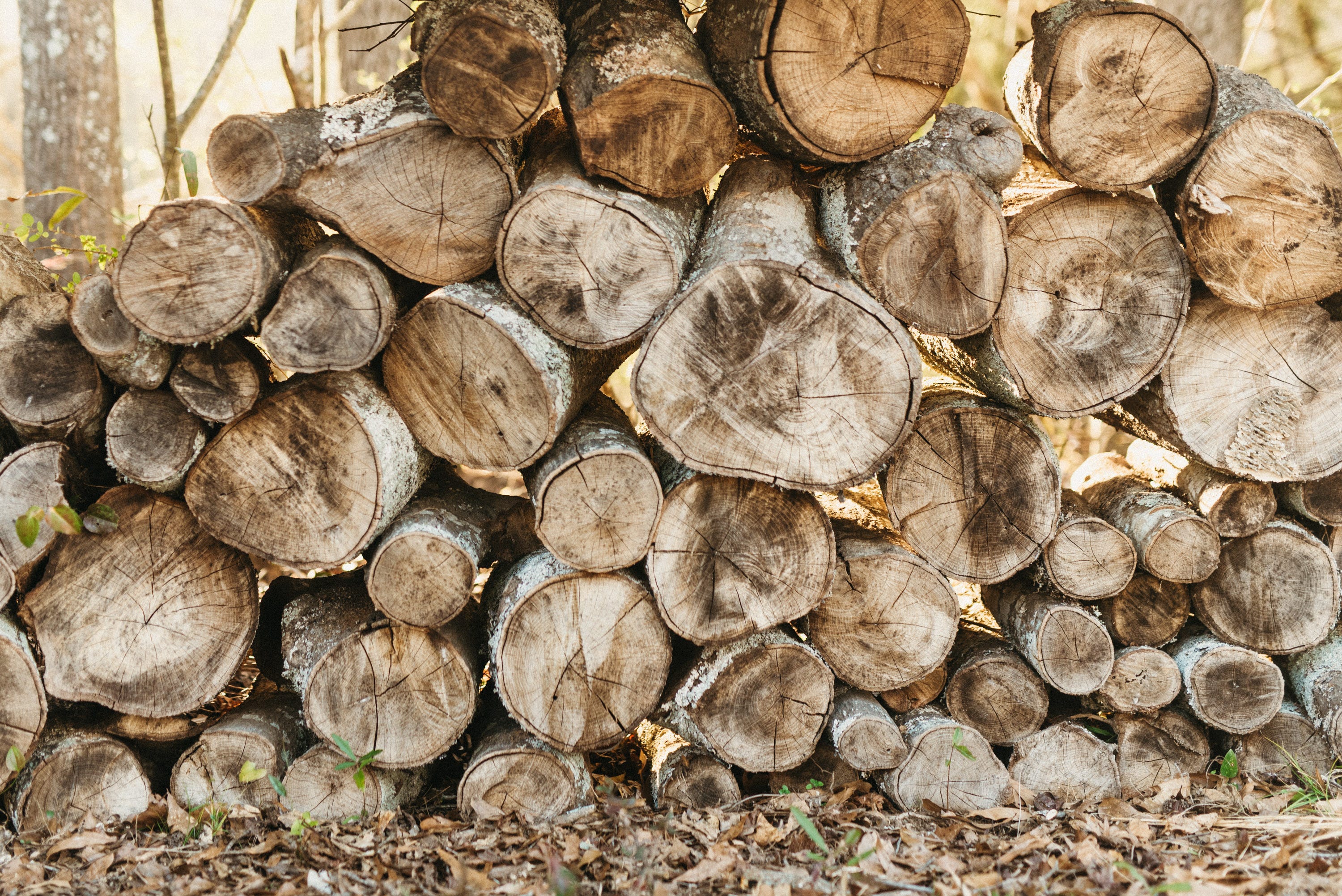
We don’t own a log splitter, but my dad does, so we made our way to his farm to collect his splitter and bring it back down to our house. My parents’ farm is just a mile and a half up the road, so the trek was easy enough.
Alex and I worked together to situate the log splitter, and then I got to work. As I lifted each log onto the splitter, pulled the lever, and collected the smaller logs once they hit the ground, I felt an overwhelming since of satisfaction. Not only did it feel great to use my body in such a meaningful way, but I was reconnected to something primal. I wondering, why does it feel so good to split the logs I know are going to warm us over a bonfire or in our wood burning stove? What is it about being physically involved in the life cycle of this oak tree that is making me feel more grounded, connected, and hopeful?
On some level, I suppose I was made this type of participation. Perhaps all of us, on some level, are made for this.
While I don’t have it all figured out, I do think we’re better/healthier/happier when we participate in the processes that sustain our lives. Convenience, as easy as it seems, is effectively rest without responsibility, which all too often becomes nothing short of extraction. Extracting living goods from the earth and extracting labor from the poor.
Reality begins to shift when we ask ourselves, “Where did this food come from?” and “How did these clothes get made?” We create new relationships when we consider, “Who does pick up my trash?” and “Where does this trash go?” This type of curiosity is a step away from the extractive conveniences of our time and a step toward the reciprocity we most need.
I can think of no better voice to speak to the power of reciprocity than Robin Wall Kimmerer: a mother, scientist, and enrolled member of the Citizen Potawatomi Nation. In her book Braiding Sweetgrass, she offers this insight into how we can begin embodying reciprocity as modern people. She says,
“One of our responsibilities as human people is to find ways to enter into reciprocity with the more-than-human world. We can do it through gratitude, through ceremony, through land stewardship, science, art, and in everyday acts of practical reverence.”
We aren’t likely to resolve all the fragmentation and disconnection we’re facing, but healing happens when we choose these everyday acts of practical reverence. When we inquire about where our goods come from, when we go out of our way to say thank you to those who help our everyday lives stay on track, when we put our hands to work to create what’s needed in our home places and communities. Everyday acts. Practical reverence. This is what a more beautiful way looks like.
As always, thank you for being here and for reading. Please, please let me know what’s shimmering for you in response to this post. I can’t wait to read what’s on your mind.
With love,
Bethaney
Bethaney, you articulated something that's been percolating more and more in me lately! I live in the city and recently started volunteering with a community garden nonprofit semi-regularly, and it has been the MOST unexpected, life-giving rest for me. Not only is it connecting me to the earth and where things come from, it's also a wonderful connection to people outside my normal paths. It's making me dream bigger for my own backyard, too! Thanks for taking the time to put this into words🤍
“convenience, as easy as it seems, is effectively rest without responsibility, which all too often becomes nothing short of extraction.” -- this thought made me pause. thank you for putting language to something i feel so deeply in my day-to-day life. there is a pervasive sense of dissonance in my soul because of the disconnect between all the easy, modern conveniences i enjoy, and a deeper longing to be connected to the sourcing of the energy, food, and possessions i require to live my life. i think the question i am left with after reading this is: how to bridge the gap between growing awareness and practical application? living a modern city life feels like being on a conveyer belt. it’s SO hard to opt out of all the easy, mindless, extractive practices and resourcing. it can feel exhausting, quite frankly, to be constantly having to choose “the narrow way” and find ways of moving slower and more mindfully when everything around you is built to make you numb and blindly a part of the system... thank you for sharing these thoughts and prompting greater self-awareness and discussion 🤍